ECS11: Bringing Crystallographers Together in Stockholm
From 28 June to 4 July, the 11th European Crystallography School, ECS11, took place in Stockholm. The meeting was very well received. Participants attended lectures, workshops and practical sessions covering X-ray crystallography and electron crystallography, with a focus on organic, inorganic and metal-organic crystal structures.
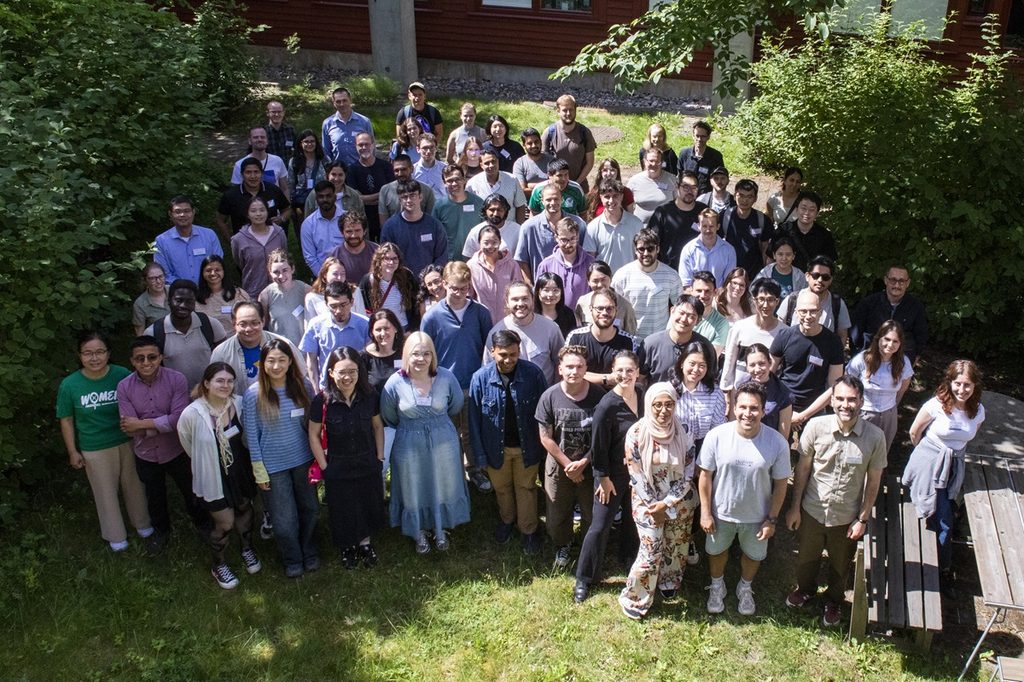
A range of social activities – including a welcome reception, a barbecue evening, dinner at the Viking-themed restaurant Aifur in the Old City of Stockholm, an excursion to the historic Ytterby mine and a visit to the Nobel Prize Museum – gave participants plenty of opportunities to network and explore Stockholm.
A total of 130 applications were received, of which 60 participants were selected. In the selection process, the organizers took several aspects into consideration. Among other things, they wanted to avoid having several participants from the same laboratory, while also ensuring a good geographical distribution across as many different countries as possible.
The European Crystallography School (ECS) is a central part of the educational activities of the European Crystallographic Association (ECA). The meetings are organized annually or biennially, each time in a different country.
The course received financial support from the ECA, IUCr and the foundation Carl Tryggers stiftelse.
Ken Inge about ECS11
Dr. Ken Inge, Stockholm University, was one of the organizers of the educational meeting.
Are you happy with how the course turned out?
– Absolutely! I think what made us organizers most happy, was that the participants were generally happy. We felt honored that many of our favorite academics agreed to teach at ECS11, and were very pleased with the talks given by representatives of a non-profit crystallographic organization and industry. This all translated to high quality and engaging lectures, demonstrations and workshops that the participants greatly appreciated, as reflected in their feedback.
– Many participants also mentioned that they were inspired by the more personal presentations, such as the career and research talks. Often in science, one only reads or hears about the final successful outcomes in a scientific publication or research presentation at a conference. We don’t often hear about the hurdles encountered in research or the personal struggles someone may have faced along the way. It can be important to hear these personal stories about how individuals overcame hardships in order to achieve that success.
How many people attended and from how many countries?
– 60 participants, 10 teachers and 14 volunteers attended ECS11 representing institutions spread across 26 countries and four continents (Africa, Asia, Europe and South America). Regarding education and career stage, participants ranged from bachelor’s students to full professors, with PhD students making of the largest group. With such an international group and hardly any of the participants knowing anyone else at the start of the school, we wanted to make sure to break the ice early so that the participants could get to know each other and feel comfortable. We arranged a number of activities including a reception, barbecue, tipspromenad, and a school dinner at a somewhat rowdy viking-themed restaurant. We wanted the school to be both educational and fun, and hope that new friendships, collaborations and networks germinated as a result of this gathering.
What was the main topic for ECS11?
– The European Crystallography Schools (ECSs) cover basic crystallography as well as advanced topics selected by the local organizs. So far every ECS has been hosted in a different country. ECS11 was the first to be held in a Nordic country, and we decided to focus on small molecule crystallography, specifically the techniques of X-ray diffraction and 3D electron diffraction.
– X-ray diffraction is a mature field that has existed for more than a century, but remains extremely important for research in chemistry today. Thanks to X-ray diffraction, we have an atomic level understanding of the structures of millions of crystalline materials including minerals, pharmaceutical compounds, catalysts, proteins and more. On the other hand, 3D electron diffraction is a relatively new technique that has undergone significant development over the past decade, and instruments dedicated to this technique have only entered the market in recent years. It is complementary to X-ray diffraction, since crystals that are too small for X-ray diffraction are often ideally sized for 3D electron diffraction. We felt it was important to teach both established and emerging techniques.
What was the highlight of the week?
– For me it was meeting people from many parts of the world and different cultures who share a passion for learning about crystallography. The school overlapped with the football World Cup, so perhaps there was an added friendly sense of celebrating internationalism at the time. We were also pleased to have the opportunity to show our international visitors how lovely Sweden is in the summer. I think many were happy to come to Sweden and escape the heatwave that was passing through large parts of Europe at the time. I look forward to seeing many of the participants again in the future, and hope to follow their development and see them become leading researchers of the next generation.
Did you do any excursions?
– We took a bus to Ytterby mine to visit the location on Earth where the greatest number of elements were discovered! We deliberately asked the bus driver to drop us off a few streets before the mine so that we could walk past some of the streets named after elements, such as Yttriumvägen. We brought a Gieger counter with us to help find gadolinite on the mine walls. I think many of the students were also pleased to find well-faceted minerals, such as white and pink feldspar, scattered around the entrance to the mine. We then took water taxis to Vaxholm for lunch, and it happened to be a pleasant summer day, ideal for ice cream!
– We ended the excursion with a ferry ride back to Stockholm and a visit to the Nobel Prize Museum. I appreciate and admire the crystal structure models on display there that were constructed by hand. While it may be tedious, I think one develops a deeper understanding of the geometry of atoms by building a model by hand rather than having computer software display one instantly. I also find it entertaining to search for the signatures of crystallography-related Nobel laureates under the bistro chairs. The Nobel Prize chocolates make great gifts, and were a popular item at the gift shop.


